Honey and Reishi Sourcing: 9 Checks for Confident Buying
honey and reishi sourcing requires two separate product reviews. For Raohe Northeast black bee honey, identify the honey presentation, proposed origin and floral-source description. For Jinzhai lingzhi, identify the species, part and finished form. Request current specifications and supporting records for the actual SKU being quoted; neither a regional name nor an attractive sample establishes every claim.
This guide is for importers, distributors and private-label buyers reviewing specialty pantry or botanical product enquiries. It compares Raohe and Jinzhai because they are distinct Maibahe origin stories, while keeping honey, royal jelly, lingzhi slices, spore powder and formulated foods separate. Product examples come from the May 2026 catalog, and current supply terms are confirmed for the proposed order.
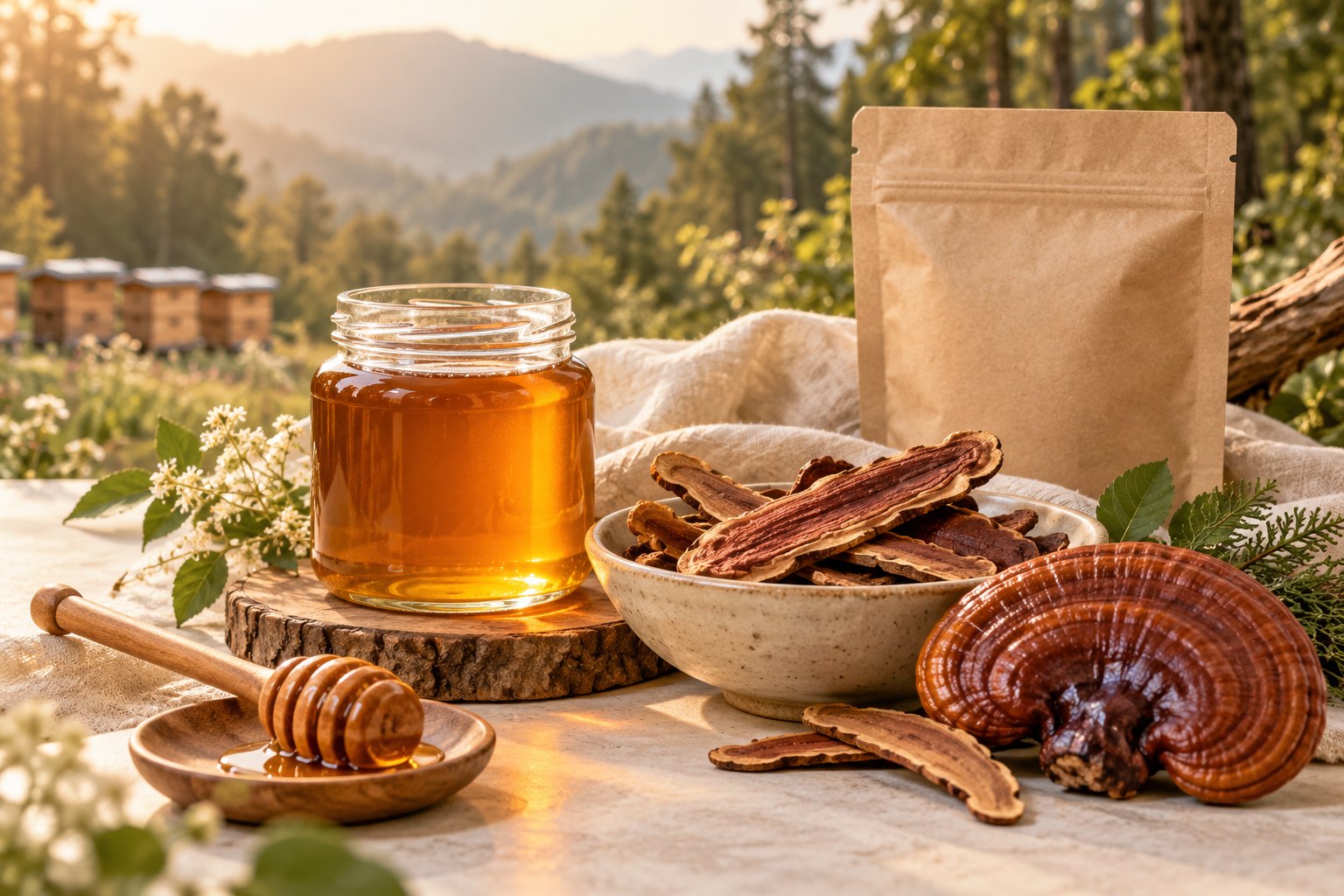
Honey and reishi sourcing: two product routes
For honey and reishi sourcing, begin with the item rather than the umbrella category “specialty foods.” A honey enquiry should identify honey rather than royal jelly, propolis or pollen. A lingzhi enquiry should identify slices, whole fruiting bodies, spore powder, an extract proposal or a finished food. A document for one form should not be reused as approval of all the forms in the same regional series.
The catalog offers a starting point for the discussion. Its Northeast black bee page presents several named bee products, while its Jinzhai pages present lingzhi forms and foods containing botanical ingredients. A current quote needs the selected name, form, composition and pack. Availability and commercial conditions may differ across items.
Use the black bee honey enquiry page and Jinzhai product enquiries as the two product anchors. For the relationship to Horqin grains and Hongyuan yak products, see the four-region origin guide. honey and reishi sourcing can follow the same evidence discipline as the other lines without borrowing their specifications or certificate scope.
| Route | Historical examples | Keep separate |
|---|---|---|
| Honey | Black bee honey, linden honey and raw-honey presentations | Honey identity, floral statement and origin claim |
| Other bee products | Royal jelly on catalog page 17 | Own composition and product documents |
| Lingzhi forms | Slices, whole forms and spore-powder capsules | Species, part and processing |
| Formulated foods | Lingzhi noodles and wholegrain biscuit | Complete recipe and finished-food specification |
Raohe black bee honey: what the origin tells you
Raohe is the relevant place entity for the Northeast black bee origin story. The catalog describes products associated with the Northeast black bee reserve and includes honey presentations using a linden description. Page 17 contains the historical product examples, while page 39 lists the company’s Northeast black bee project material. These references help identify the enquiry; they do not by themselves verify the proposed lot.
The national standards platform entry for GB/T 19330-2008 is a primary source for the geographical indication standard concerning Raohe Northeast black bee honey, royal jelly, propolis and bee pollen. It lists the standard as currently effective and records a 2025 review continuing its validity. This provides regional and standards context, not a certificate of eligibility for every supplier or SKU.
For honey and reishi sourcing, ask the supplier to identify the proposed honey product and the records supporting its origin statement. If a geographical indication statement is material to the order, ask what entitlement and product-specific evidence support its use. Do not infer the right to use a designation simply because a regional standard exists.
Distinguish floral source from bee-source and place-source wording. A “linden” description concerns a proposed floral identity, while “Raohe” concerns geography and “black bee” concerns the bee-product story. These statements may be related, but your review should identify the basis for each one rather than treat them as synonyms.
Jinzhai lingzhi: species, part and finished form
Jinzhai in Anhui is the catalog’s lingzhi origin entity. Page 20 presents lingzhi slices, whole lingzhi, spore-powder capsules and a noodle product. Page 23 includes a formulated wholegrain biscuit. A 100 g slice presentation and a 200 g noodle presentation are historical examples; they are not a current wholesale offer or a reason to use the same documents for both items.
The Jinzhai county lingzhi development plan discusses germplasm, cultivation capacity and processing. It includes multiple production approaches. That context is useful when asking about cultivation, but it does not establish the method used for an individual Maibahe item. A regional lingzhi story should lead to a product-specific identity question, not a universal claim about all mushrooms from the county.
For honey and reishi sourcing, request the species or identity description used in the current specification, the part used and the finished form. Fruiting-body slices and spore powder are not interchangeable. An extract has a different processing description from dried slices, and it should only be discussed as a supplied form when the team confirms that offer.
Ask who produces and packs the item and what records connect it to the proposed source. For a finished noodle or biscuit, review the complete ingredients and the declared role of the lingzhi ingredient. Do not transfer the identity or composition of a raw botanical material to the entire formulated food.
Honey specification and sample review
A honey brief should name the proposed product, pack and intended use. Ask for the current product specification and the description of processing relevant to the offer. If words such as “raw” or “linden” matter to your range, ask how the supplier describes and supports them. A historical catalog statement should remain a reference until the proposed SKU and records are identified.
In honey and reishi sourcing, keep sample observations separate from laboratory evidence. Color, aroma and texture may help your team assess the sample, but visual appeal does not establish origin or analytical values. If a report is part of your approval, check its sample or lot reference, date and scope before applying it to the order.
Ask which quality parameters and tests can be documented for the proposed purchase. Agree requirements with the people responsible for your product and market review. Do not copy an enzyme figure from a catalog into a guarantee for every shipment. A specific historical value needs its own product and test context.
Record the sample identifier and the proposed specification revision. Check packaging, closures, label draft and supplier instructions for storage and shelf life. Any change in product description or pack should be visible in the approval log. honey and reishi sourcing becomes more reliable when your decision refers to the actual sample and paperwork rather than a general product-line story.
Reishi identity, processing and document questions
Start a lingzhi brief with the desired form and the purpose of the enquiry. Ask for the identity information used by the supplier, relevant part and processing description. A slice enquiry can include dimensions or appearance fields where appropriate; a spore-powder or extract enquiry needs its own description. Avoid comparing prices before the forms are actually comparable.
For honey and reishi sourcing, request the product specification and any available identity or batch documentation that your review requires. Check how the report describes the sample. If a composition claim is important, ask for its basis and scope instead of assuming that a regional cultivation story establishes a measured level in every item.
Cultivation descriptions should be product-specific. The historical catalog mentions a log-grown story for certain Jinzhai items, while the government plan describes a broader regional industry. These sources do not prove that every current SKU has the same cultivation method. Ask which records or producer information support the description being proposed.
For a formulated food, obtain the full finished-product recipe and proposed label. For another finished category, have the responsible target-market reviewer confirm the applicable route before committing to artwork or promotion. This guide does not offer dosage or therapeutic advice. honey and reishi sourcing here concerns product identity, evidence and commercial review, with claims approved separately for the selected item.
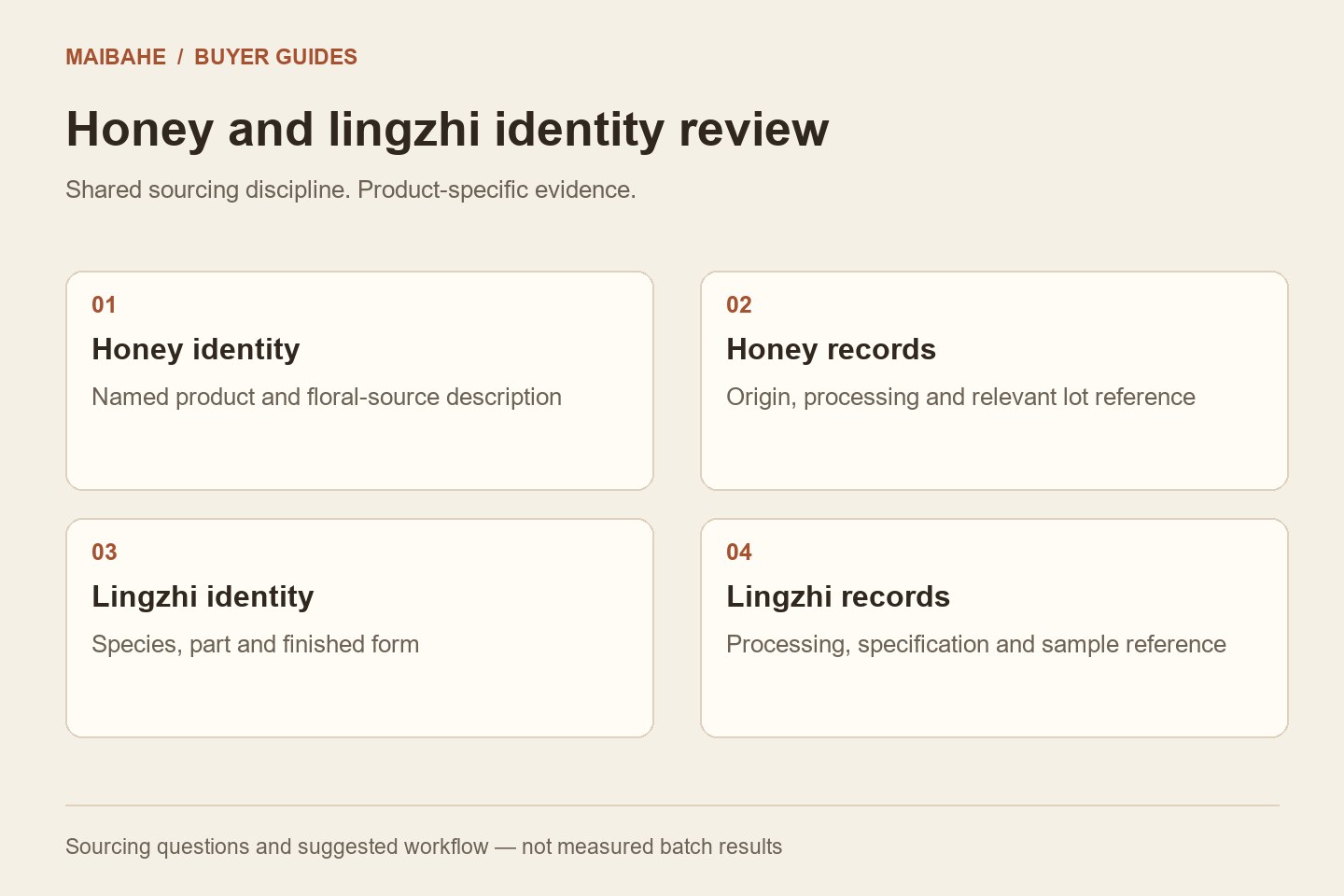
Nine essential honey and reishi sourcing checks
Use the following sequence for honey and reishi sourcing. It helps a buyer decide what needs to be agreed before a sample, label or order can be approved. Keep one record per selected item, even when several items share a brand or purchase destination.
1. Define the form
State honey, royal jelly, lingzhi slices, spore powder or a named finished food. Avoid an umbrella term that hides a different composition.
2. Identify the place
Request the source statement for the selected SKU. Keep historical and current sources distinguishable.
3. Identify the operator
Confirm who produces, packs and supplies the quoted item. The regional story does not establish the commercial relationship.
4. Ask for a current specification
Check revision, ingredients or identity, form, packing and supplier instructions against the proposed offer.
5. Match the sample
Record sample reference and what your team reviewed. Appearance alone should not resolve origin or test questions.
6. Review reports by scope
Check sample or batch identifiers, dates and the actual reported fields. Do not turn a single report into an all-product statement.
7. Review the claim
For origin, floral-source, certification or identity wording, identify the supporting record and approval responsibility.
8. Agree the pack and quote
Clarify quantity, weight, artwork, destination, sample terms and exclusions. Commercial conditions need written confirmation.
9. Confirm receiving requirements
Specify which approved references and documents must accompany the proposed shipment. Revisit approvals when key fields change.
Compare the documents without mixing the categories
A comparison sheet should reflect the product category. Honey needs its proposed identity and relevant origin, floral and processing information. Lingzhi needs its species or identity, part and finished-form information. Both need an operator, current specification, sample reference and quote scope. Similar columns can organize the work, but they should not force different products into one shared specification.
For honey and reishi sourcing, record why each requested file matters. A regional government report is useful context, a certificate describes its defined scope, and a lot report describes the identified sample or batch. None should be relabeled as the other. This makes document gaps visible without dismissing useful background information.
Ask the supplier to explain any mismatch in names, dates or identifiers. A transliteration difference may need clarification, while a different product form may require another document entirely. Store the explanation with the record so your team does not repeat the same question or accidentally approve an alternative.
The quality document page is an enquiry starting point. The supplier comparison guide offers a reusable comparison discipline. When applying it to honey and reishi sourcing, adapt the identity fields to honey or lingzhi instead of importing an oat-format checklist unchanged.
| Evidence type | Useful for | Does not establish by itself |
|---|---|---|
| Regional government source | Geographical and industry context | Current SKU, ownership or order capability |
| Historical Maibahe catalog | Past item and pack presentation | Current offer or current certificate scope |
| Current specification | Proposed product definition | Every historical or future batch |
| Certificate | Named operator, product/activity and validity | Products or claims outside its scope |
| Sample/lot report | Identified sample or batch and reported fields | Unreported attributes or all product lines |
| Written quotation | Commercial assumptions for the proposal | An unconditional offer beyond stated terms |
A worked Raohe and Jinzhai range review
An illustrative specialty retailer is considering a linden honey presentation and lingzhi slices under a common pantry design. The retailer has not approved source wording, pack weights or a current supplier. Its first enquiry names two rows rather than asks for a single “wellness product” quote. This is a planning example, not a real customer order or a confirmed Maibahe supply arrangement.
For honey, the buyer requests the proposed SKU, honey description, floral-source information, origin evidence, sample and current packaging options. For lingzhi, it requests species or identity, fruiting-body slice form, processing description, sample and available supporting records. The destination and design brief can be common; product evidence remains separate.
The team reviews the honey sample for the intended use and compares its paperwork with the proposed label text. It reviews the lingzhi sample against the requested form and checks the supplied identity description. A report is logged with its reference and scope. Where a claim lacks supporting information, the team keeps it out of the label until the question is resolved.
In honey and reishi sourcing, a supplier may propose another form or pack. The buyer records that alternative separately and decides whether it still fits the range. If the proposed item changes from slices to powder, the review restarts for the changed fields. An initial approval is not permission to substitute any product in the same regional line.
Once product and label scope are settled, the buyer compares quotes on the same quantity and destination basis. The receiving checklist names the approved specifications and required documents. This keeps the brand story connected to the item that will actually be received, rather than to a general impression of the region.
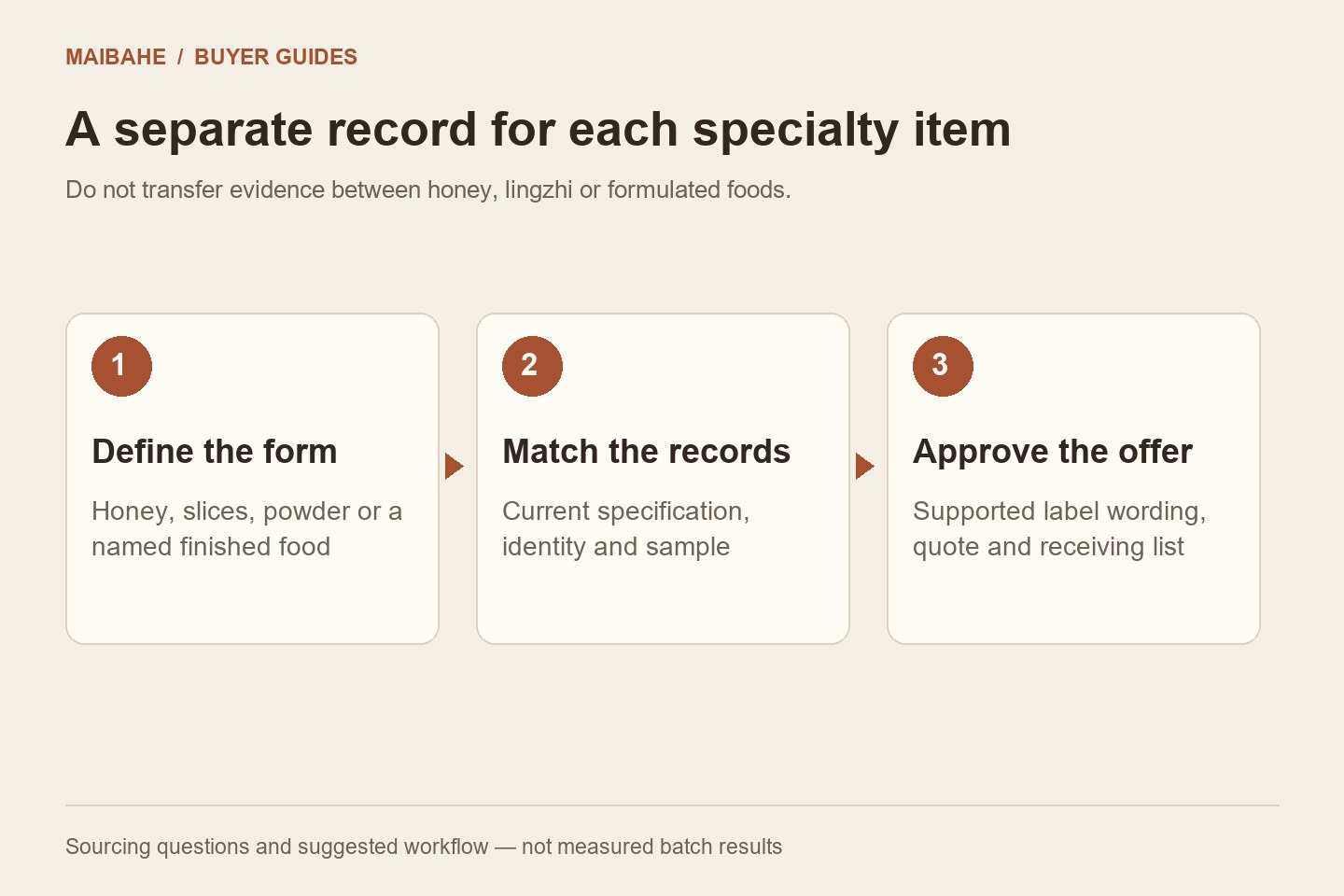
Honey and reishi sourcing questions answered
Does the Raohe geographical indication standard certify a Maibahe honey lot?
No. The standard is regional and product-related context. Ask for evidence supporting the proposed SKU or lot and its use of any designation.
Are lingzhi slices, spore powder and extracts interchangeable?
No. They describe different parts or processed forms. Request the specification and identity information for the form being offered.
Can a honey sample prove a linden or raw claim?
A sample alone does not settle the evidence question. Ask for the supplier description and supporting records for the proposed wording.
What makes honey and reishi sourcing documents useful?
They identify the actual product, operator, revision, sample or lot and scope. Generic files with unclear applicability leave purchasing questions unresolved.
Can the historical catalog establish current price or MOQ?
No. Current commercial conditions, sample arrangements, export packing and timing require a written response for the proposed order.
A sourcing brief you can send today
Turn honey and reishi sourcing into a defined enquiry. Send the product name and form, intended use, first-order quantity with its unit, packaging preference, destination and desired decision date. Add the documents needed for your review and identify which questions can remain open until a sample is available. Separate a forecast from a committed order so the supplier can review the correct volume.
Ask the Maibahe team to return a written scope: proposed SKU, specification version, available packaging, sample arrangements, commercial assumptions and evidence that can be provided. If the reply proposes an alternative, keep the original request and the alternative in separate columns. That makes changes visible when purchasing, packaging and sales colleagues review the project.
The website and historical catalog are useful starting points, while the current specification and quotation define the proposed supply. Do not treat a past pack size as the export minimum, a regional industry report as a factory audit, or a certificate title as proof of current coverage. An unanswered field should remain a recorded question rather than become an assumption in your customer-facing copy.
Keep the approved sample identifier, artwork version, document list and quotation together. When the product, package or destination changes, ask whether the same documents and supply terms still apply. Use a receiving checklist that matches what you actually approved; the existence of a successful previous order does not define the scope of a different SKU.
Start with a product-specific enquiry, review OEM and private-label planning, and use the grain RFQ checklist where relevant. For the broader origin map use China food origin sourcing and compare the distinct grain and yak dairy breakfast route.
Sources, dates and evidence scope
Prepared on 7 October 2026. Product examples come from the Maibahe product catalog dated 11 May 2026, available through the catalog and buyer documents page. Page references in this article identify historical presentations; they are not a current offer or a verification of every promotional statement in that catalog.
Regional sources establish geographical or industry context only. They do not establish Maibahe ownership, certification, an individual lot’s origin, or a trading relationship with the named organizations. The available records for a proposed purchase must connect to the selected product and operator. Illustrative scenes and diagrams explain sourcing decisions; they are not photographs or test results from Maibahe facilities.