Grain Supplier Checklist: 9 Essential Checks for Smart Buying
Maibahe Buyer Guides · Updated 4 October 2026
A grain supplier checklist should compare product fit, current specifications, supporting documents, sample identity, packaging, quotation scope, schedules, communication and receiving arrangements. Use the same fields for every supplier. Mark unanswered items clearly before making a purchasing decision.
This guide is for buyers reviewing wholesale oats, millet, black rice and grain blends. It provides an evidence-based comparison method, not a supplier ranking. Maibahe’s product catalogue is a historical reference; current availability, order conditions and document scope are confirmed for the proposed SKU and destination.
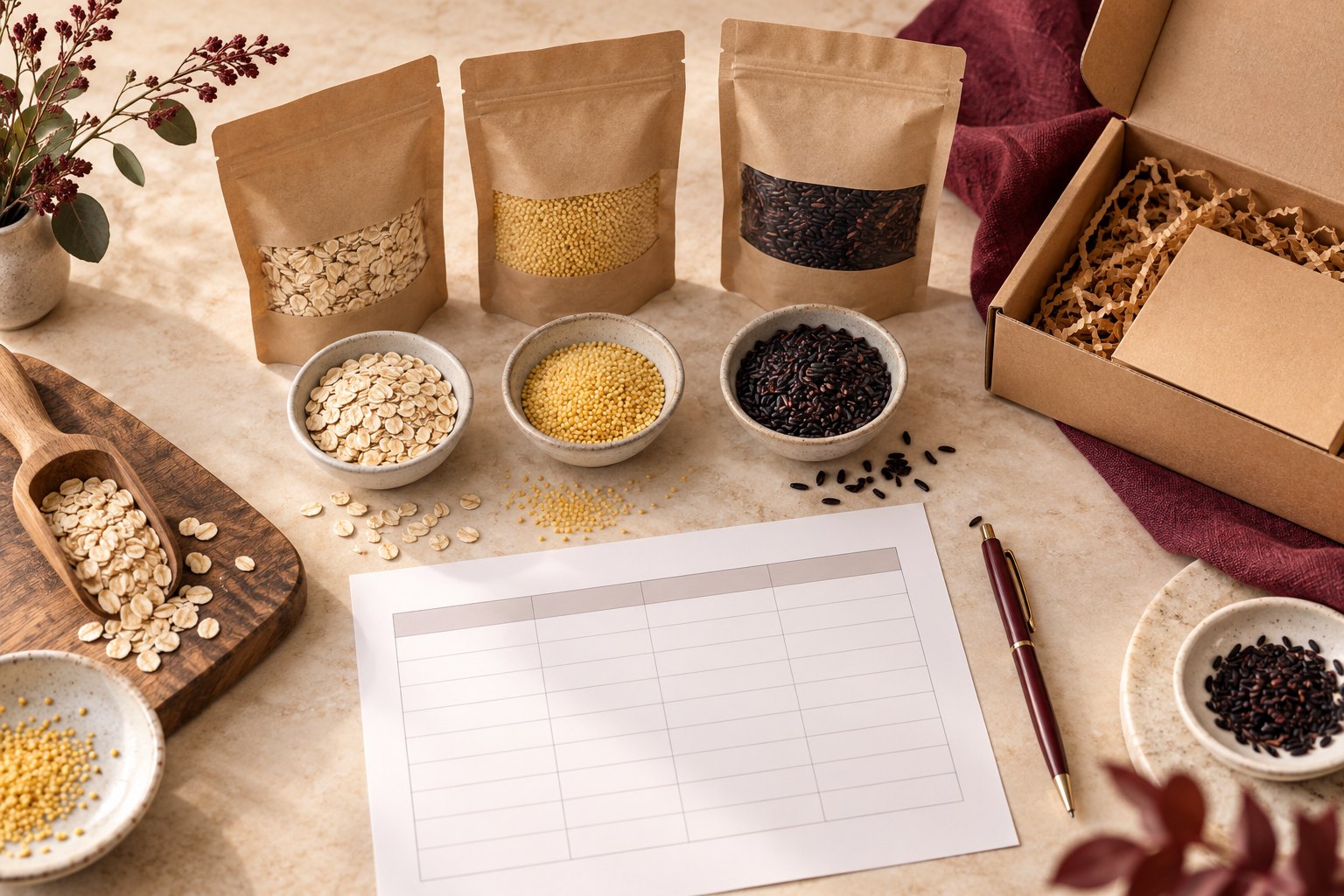
Grain supplier checklist: compare the proposed order
Start the grain supplier checklist with one sourcing brief. If suppliers quote different recipes, pack weights or receiving points, headline prices will not answer the same question. First define the grain, format, intended channel, quantity, pack and destination. Then ask each supplier to confirm what it can offer and which requested details remain open.
A grain supplier checklist separates three kinds of information: a supplier’s proposed offer, evidence supplied for that offer, and your review decision. Keep all three visible. A clear proposal is useful, but supporting documents must match its product and scope. A document can be genuine and still be irrelevant to the SKU you are considering.
Nine essential checks for confident supplier comparison
1. Confirm product and application fit
Identify the exact grain format and intended use. Review whether the supplier offers the plain ingredient, finished retail pack or custom blend you need. State the channel and destination. Maibahe buyers can start with rolled oats, millet or black rice. Keep separate rows for separate SKUs so a mixed response does not hide a missing product.
2. Ask for a current specification
Request the product name, code, recipe, pack, labelled conditions and revision date. Compare the same specification fields across suppliers. A historical catalogue is useful for identifying formats, but the current specification defines the proposed order. For oat-specific fields, use the rolled oats specification guide. Record any proposed alternative instead of assuming it matches the original request.
3. Check document identity and scope
For each certificate or report supplied, check the named entity, product, issue date, validity, sample or batch identity and stated scope. Ask the supplier to explain the connection to your order if it is unclear. A grain supplier checklist should not award credit merely for the number of badges displayed. Ask which documents are relevant to the destination and which must be reviewed separately.
4. Review origin information carefully
Ask what origin information is available for the selected grain and how it connects to the proposed product or batch. Distinguish a regional description from a lot record and a brand story from a verified ownership relationship. The Maibahe origins overview can guide questions, but your buying decision should use the actual records supplied for the SKU. Do not infer pesticide, certification or traceability claims from geography.
5. Tie the sample to the proposed product
Request a named sample with enough information to identify the recipe and format. Agree what your team will evaluate and preserve the observations. Confirm whether the sample represents an existing product or a proposed custom formulation. Ask how any differences between the sample and production specification will be resolved. An unlabelled sample is difficult to use as an approval reference.
6. Align packaging and private-label responsibilities
Compare net weights, materials or required performance, closures, carton configuration and label work. Identify who prepares and approves the artwork. For a custom project, ask about formulation, packaging and document dependencies before selecting a supplier. The OEM and private-label overview helps frame this discussion. The grain supplier checklist should distinguish product supply from development or branding work.
7. Compare the full quotation scope
Ask for the quantity unit, currency, validity, named delivery point, included work, excluded charges and payment schedule. Record any alternatives. A quote for product collection and a quote including delivery cannot be compared as if the responsibilities are identical. Ask for clarification rather than filling gaps with assumed freight, duties or sample charges. Use written terms for the final purchasing review.
8. Separate schedule stages and dependencies
Request estimates for sampling, approval, production, dispatch and transport. Ask what starts each stage and what happens when artwork or ingredients change. A desired arrival date is useful input but is not evidence of a supplier commitment. Keep the grain supplier checklist updated when the order scope changes, and ask for a revised schedule rather than relying on the earlier estimate.
9. Agree communication and receiving procedures
Identify contacts for commercial questions, document review and delivery exceptions. Ask how specification changes are communicated and how your team should raise a discrepancy. Prepare a receiving record that links the delivered lot to the approved order and specification. Clear responsibility makes the comparison more practical than an unsupported claim of excellent service. Record the agreed next step and the person responsible for it.
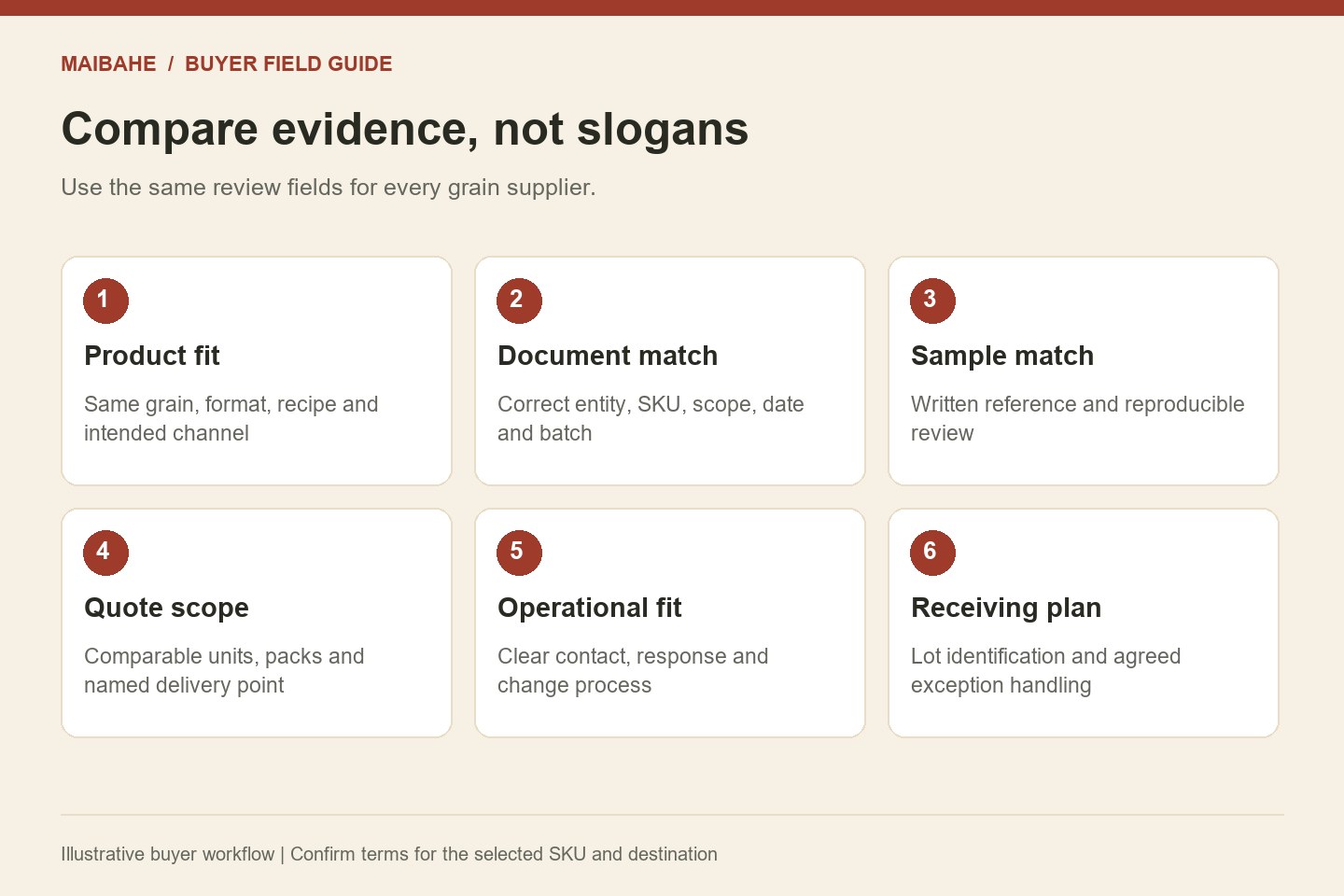
Build a grain supplier checklist worksheet
| Review field | Evidence to request | Status to record |
|---|---|---|
| Product match | Named SKU, format and ingredients | Matched / alternative / unanswered |
| Current specification | Dated revision with agreed fields | Received / incomplete / pending |
| Document relevance | Entity, scope, dates and batch reference | Reviewed / clarification needed |
| Sample identity | Sample reference and review notes | Accepted / conditional / pending |
| Quote scope | Units, packs, delivery point and exclusions | Comparable / different basis |
| Receiving plan | Lot identification and exception contact | Agreed / unresolved |
Add a grain supplier checklist column for each supplier, but avoid combining unresolved fields into an invented overall score. Your review team can decide which fields are essential for the intended use. Record the reason for a decision and identify any condition that must be resolved before an order is approved. An unanswered essential item should stay visible even if other details look attractive.
The grain supplier checklist is especially useful when one proposal includes an existing retail pack and another includes custom artwork. Label the routes separately. If both suppliers later quote the same revised brief, keep the old version for the record and compare the new replies against the new revision.
Follow the evidence from sample to receiving
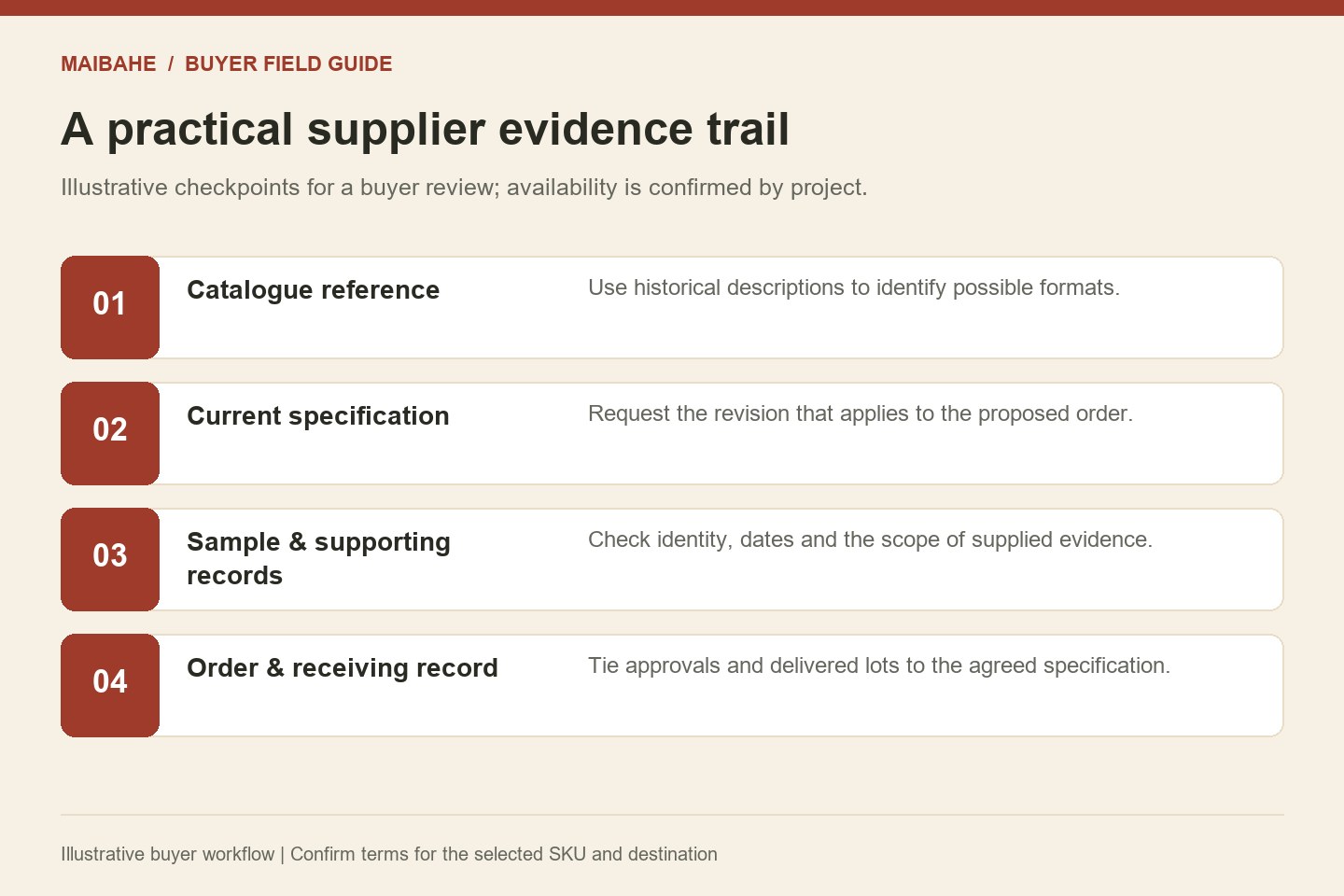
Use the grain supplier checklist to maintain a simple chain of references: sourcing brief, current specification, sample review, supporting records, artwork if relevant, quotation and order, then receiving record. Each should identify the product clearly enough to relate to the next. A reference chain helps your team spot a changed pack or recipe before it becomes a delivery dispute.
For example, a buyer comparing black rice can ask every supplier for the same proposed pack weight, order quantity and destination. If a sample arrives with a different product description from the quote, pause the product comparison and request clarification. This is an illustrative review scenario, not a reported Maibahe customer case. The principle is to resolve identity differences while the decision is still open.
Use Maibahe’s quality document request page to ask about available evidence. Keep the grain supplier checklist alongside the actual records received. A website statement that documents can be requested does not confirm that your review requirements have already been met.
Common mistakes when comparing grain suppliers
- Comparing per-pack prices without checking net weight and units per carton.
- Treating a past catalogue presentation as a current export quotation.
- Applying a certificate from one product line to another SKU.
- Assuming an attractive sample proves every document or production requirement.
- Mixing first-order quantity with an uncommitted yearly forecast.
- Treating a transport estimate as a confirmed arrival date before approvals.
- Approving artwork without identifying the matching product specification.
Use the grain supplier checklist to correct these issues by requesting a revised, written response. Use the same updated sourcing brief for every supplier where comparison is still needed. The goal of the grain supplier checklist is a reviewable decision with clear assumptions, rather than a larger collection of unconnected marketing files.
Build a grain supplier checklist review log
A grain supplier checklist review log should make the sourcing decision understandable to a colleague who was not involved in the initial conversations. Start with the dated brief and proposed product, then add the response and supporting records from each supplier. Keep alternatives visible. The grain supplier checklist is most useful when it records the actual state of the review rather than reducing uncertain information to a confident-looking total score.
Record the response and the evidence separately
For each field, write: “Buyer requirement: [requirement]. Supplier proposal: [proposal]. Supporting record: [document, date and scope]. Reviewer decision: [accepted, clarification needed or alternative to review]. Owner and next step: [details].” For example, a proposed pack can be clearly described in a quotation while its artwork remains unapproved. Record both facts. One complete field does not imply that all related approvals are complete.
Give unresolved questions a decision status
Ask whether an unresolved item affects product selection, sample review, quotation comparison or order approval. Mark the decision it blocks and the person responsible for following up. A grain supplier checklist can include a requested reply date for planning, but that is a buyer request until the supplier confirms it. Do not turn an internal target into a promised response time or production commitment in the supplier record.
Preserve alternatives instead of overwriting the request
If a supplier proposes a different grain format, pack or order size, create an alternative row. Keep the original requirement beside it and identify the change that your team must consider. If the alternative is accepted, update the sourcing brief and ask for a matching written proposal. Apply the same updated brief to other suppliers where comparison continues. This keeps the grain supplier checklist coherent when the purchase evolves during discussion.
Distinguish evidence availability from evidence approval
A supplier may state that a report can be supplied. Record that as availability to confirm, not as a reviewed result. When a file arrives, check its identity and scope, then record the actual review decision. If it covers another SKU or period, ask about relevance. A grain supplier checklist should retain these differences so a later buyer does not mistake a requested certificate, an available certificate and an approved applicable certificate for the same thing.
Keep supporting records with the grain supplier checklist review log using stable filenames or internal references. Include a date and the relevant SKU wherever practical. A short summary is helpful, but it should point to the complete document. Store the supplier clarification with the file if the relationship to the product was explained separately. This reduces the risk that the useful explanation is lost while the attachment continues to circulate.
An illustrative comparison with different pack proposals
Imagine a buyer requesting plain oats for a retail project at a target pack weight and a stated total first-order quantity. One supplier replies with an existing labelled pack. Another replies with a proposed private-label presentation. Their prices may both be valid for the offers described, but they do not yet represent the same work. This is an editorial example, not a reported customer transaction or a claim about Maibahe’s current order options.
The buyer can use the grain supplier checklist to record recipe, net weight, units per carton, label language, artwork responsibility, sample terms, documents, order minimum, schedule and delivery basis for each offer. Any missing field stays pending. If the private-label route includes development work, ask what is included and what approvals start the schedule. If the existing pack is an acceptable alternative, record the buyer’s decision and the relevant reasons.
Next, decide which comparison is useful. The buyer may request both suppliers to quote one revised pack requirement, or may evaluate the two routes as distinct project options. Either approach can be valid if the scope is explicit. The mistake is comparing two headline unit prices while assuming the ingredient, pack and branding work are identical. The grain supplier checklist makes those assumptions visible before a selection is made.
If the order mix changes from one SKU to several, ask for a revised proposal. Do not assume that the total volume alone determines the commercial conditions. Packaging runs, recipes, labels and delivery arrangements may have dependencies that the supplier needs to explain. Record the explanation against the changed field and keep the previous quotation for context. Use the new quotation, not an assembled mixture of old and new terms, for the final review.
Hand over a supplier decision with clear conditions
Write a grain supplier checklist decision note after reviewing the candidates. Identify the selected product and supplier proposal, the records reviewed, why the offer fits the intended use, and any condition that must be resolved before ordering. Keep other proposals as comparison evidence. The grain supplier checklist supports the decision; it should not imply that a supplier has passed an independent audit unless an actual applicable audit has been completed and reviewed.
Include the grain supplier checklist, current specification, sample reference, artwork status if relevant, quotation revision and receiving plan in the handover. If a document or sample approval remains pending, name the person who will resolve it. A clear handover prevents the supplier contact, purchasing reviewer and receiving team from working from different versions. It also makes later changes easier to assess because the earlier approved basis is still identifiable.
For subsequent orders, review what has changed rather than assuming every field stays current. Ask about product, source information, recipe, pack and relevant document changes, as well as the new commercial offer. Preserve the earlier grain supplier checklist as a record of that decision and open a dated update for the new one. Your team can then distinguish a supplier’s past proposal from its current commitment.
Use the review record to ask better questions on the next project. Repeated unresolved fields may show that the original brief needs more clarity or that a proposed supplier route does not fit your requirements. These observations are operational feedback, not public performance rankings. Keep the comparison objective and tied to the evidence for the actual SKU, market and purchase under consideration.
Grain supplier checklist questions buyers ask
How many suppliers should I compare?
Choose enough candidates to review meaningful alternatives with the information your team can evaluate. This guide does not prescribe a universal number. A complete comparison of a few relevant proposals is more useful than incomplete records for many unrelated offers.
Is the lowest grain price always the most useful quote?
A price becomes comparable only when the product, quantities, packs and delivery responsibilities are aligned. Check the scope and unresolved requirements before choosing between offers.
Does a supplier’s organic badge cover every grain?
No such assumption should be made. Request current evidence for the named product, entity and market, then review the stated scope and validity. A historical statement on a different product line is insufficient.
Can a historical catalogue support a supplier shortlist?
Yes, as a reference for the assortment and formats you want to discuss. Ask for current availability and a dated specification before treating it as an order proposal.
What should I do when a supplier offers a different pack?
Record it as an alternative. Ask for its actual net weight, carton configuration, label requirements, MOQ and quotation basis. Recompare offers only after the differences are visible.
Send a sourcing brief suppliers can compare
Use the grain RFQ checklist to prepare one clear brief. For Maibahe, include company, destination, channel, selected product, quantity, pack and branding requirements. List the evidence your team needs and explain any flexible points. Send your grain sourcing inquiry and keep the reference for follow-up.
Related resources: product catalogue and buyer documents and wholesale buyer FAQ. If your UK review includes allergen requirements, refer to the official allergen guidance for food businesses. The comparison method above is editorial guidance; final product and commercial terms come from the agreed documents.