Grain RFQ Checklist: 9 Essential Steps for Confident Buying
Maibahe Buyer Guides · Updated 4 October 2026
A grain RFQ checklist turns a broad request for a price into a sourcing brief that a supplier can review. Include the exact grain format, intended use, quantity and unit, pack weight, destination, label needs, required documents and target arrival date. Ask for a written quotation that separates the product offer from the delivery assumptions.
This guide is for importers, distributors and private-label buyers comparing oats, millet, black rice or a grain blend. It explains what to ask and how to compare replies. Maibahe product pages reference the historical May 2026 catalogue; current availability, export packs, MOQ, samples, pricing and schedules are confirmed for the selected project.
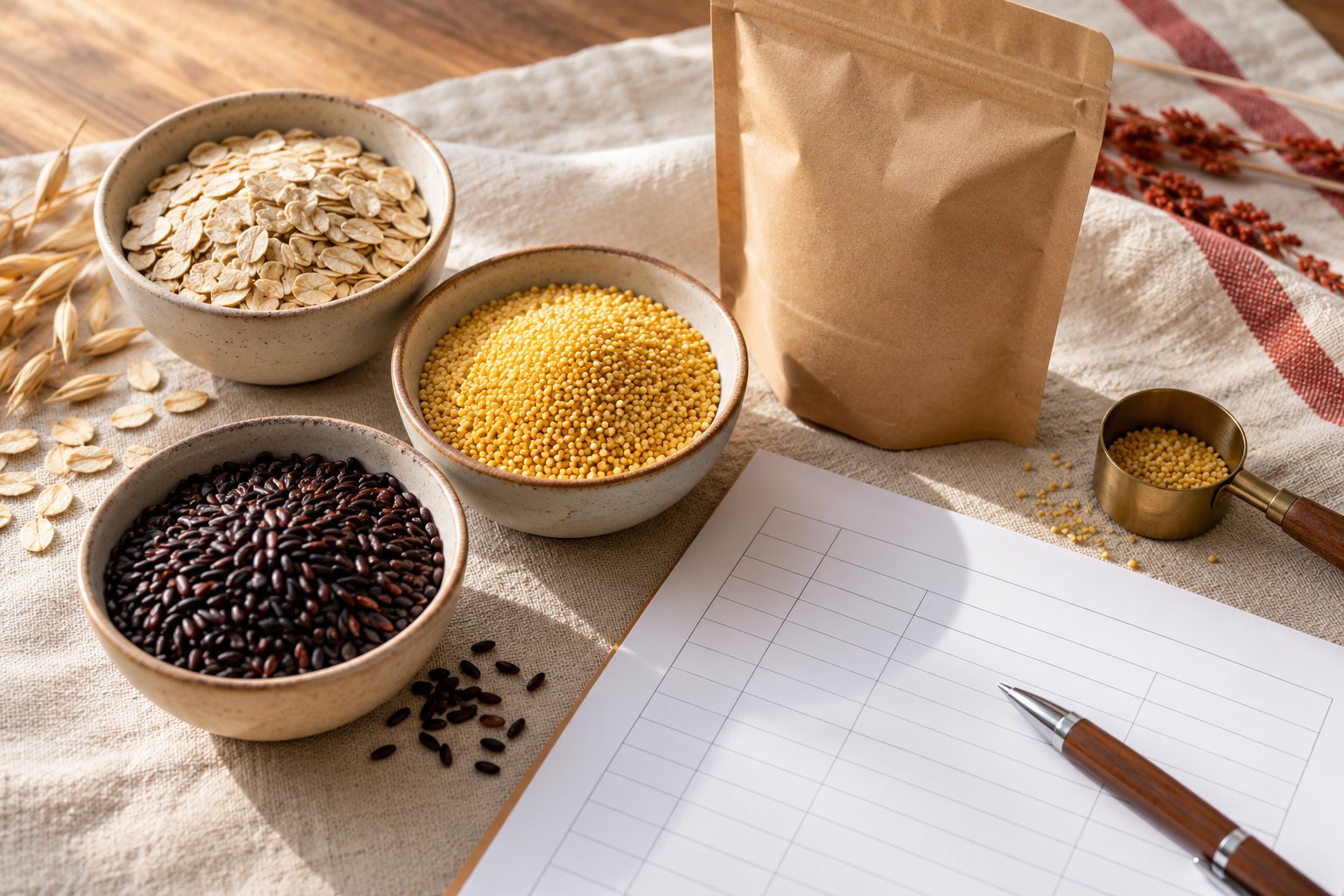
Grain RFQ checklist: the quick answer
Send enough detail for the supplier to identify one proposed order. A quotation for plain oat flakes in an existing pack is a different request from a new multigrain recipe with private-label artwork. Separating these routes makes unanswered questions visible before you compare prices.
| Information | What to put in the brief | Why it matters |
|---|---|---|
| Product | SKU or clear grain name, format and ingredients | Identifies what is being priced |
| Quantity | Total kg, packs, cartons and number of SKUs | Prevents unit and order-mix errors |
| Pack | Net weight, outer carton and label requirements | Defines packaging work |
| Destination | Country, receiving city or port and channel | Defines the requested quotation basis |
| Documents | Specification, allergens and requested batch evidence | Clarifies the review workload |
| Timing | Sample target, order decision and desired arrival | Separates approval time from shipment planning |
Use the product range to identify a line, then review the relevant rolled oats, millet or black rice page. A grain RFQ checklist should refer to a selected product rather than treat every item in a catalogue as interchangeable.
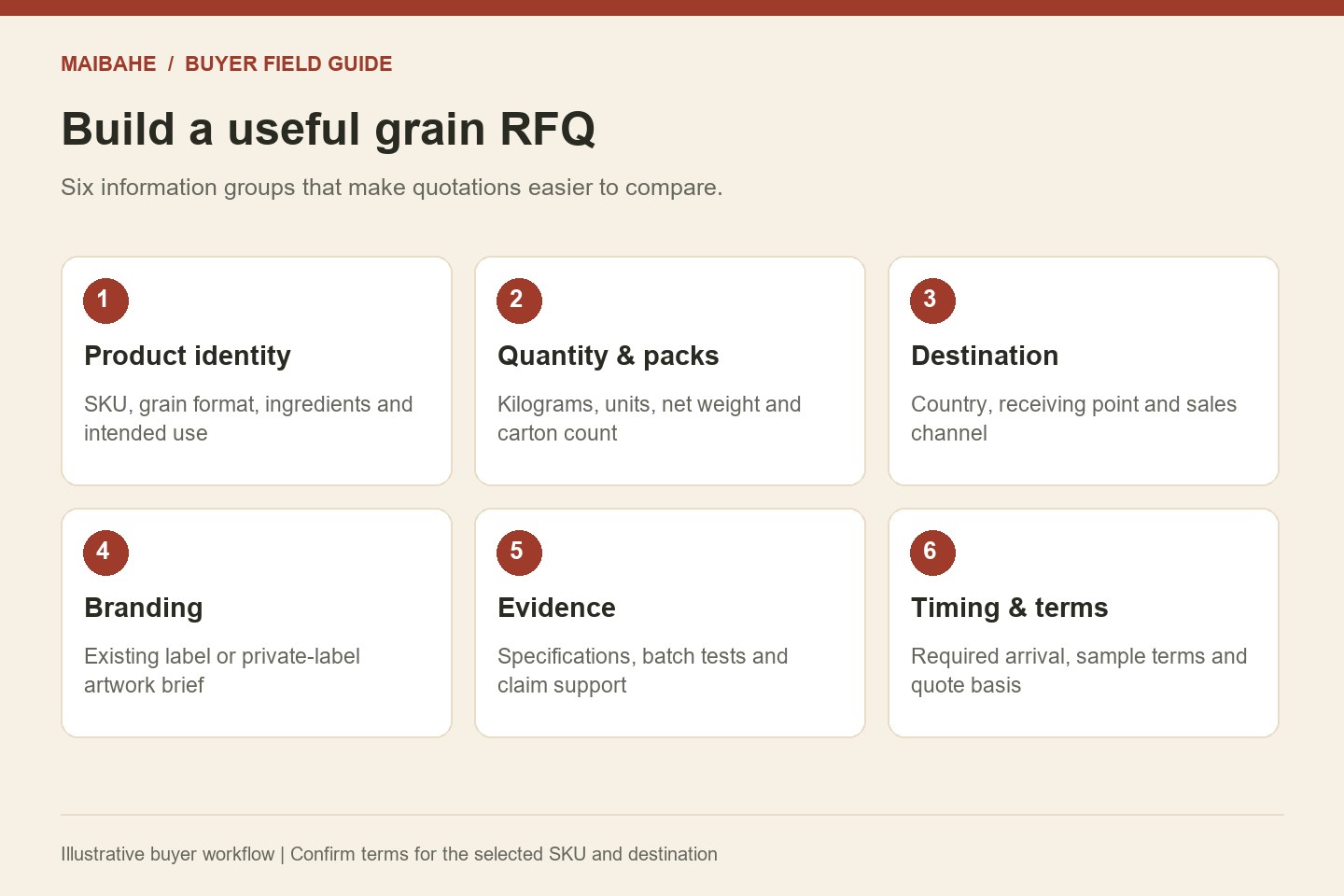
Nine essential steps for a confident grain sourcing brief
1. Name the product and the use
Write whether you need instant flakes, larger oat flakes, a whole grain or a formulated blend. Explain the intended use, such as a breakfast retail range, food-service ingredient or congee mix. Ask the supplier to identify the proposed SKU and current ingredient list. If you attach a catalogue page, state that it is a reference for the format you want.
2. Put every quantity in a defined unit
Give the proposed first-order volume and distinguish it from a forecast for future orders. Use kilograms for the total grain weight and units for finished packs. State how many SKUs share the volume. A quote for several small label runs may have a different basis from one larger run, even when the total weight is the same.
3. Specify the pack you want reviewed
State the target net weight, preferred pack type and outer-carton needs. Indicate whether an existing pack is acceptable or you need a new format. Ask the supplier to confirm what can be offered before commissioning artwork. Historical retail sizes describe a past presentation; they do not establish current bulk packing or a fixed export offer.
4. Give the destination and channel
Include the destination country, city or named receiving point, and whether the product will be sold online, through retail, in food service or to another processor. Explain the label language you need. Country alone may be insufficient to assess a delivery request, while the sales channel helps the team understand presentation and document needs.
5. Separate standard supply from private label
For standard supply, identify the existing product and packaging you want quoted. For private label, attach an ingredient brief, proposed pack and artwork requirements. Allocate responsibility for preparing, reviewing and approving the label. Use the OEM and private-label overview for this route. Do not assume a standard product quotation includes formulation development.
6. Ask for the relevant evidence
Request a current specification, complete ingredients, allergen information, labelled shelf life and storage conditions. List any requested batch tests or certification claims. Ask whether each document applies to the proposed SKU, entity, market and validity period. The quality document page is a starting point for this discussion, not proof that every claim covers every product.
7. Define the sample review
Specify the sample product, intended evaluation and delivery address. Ask about availability, sample quantity, charges, courier costs, documentation and dispatch timing. State whether you need an existing product sample or a sample of the proposed custom recipe. The grain RFQ checklist should record these as separate requests; the website does not advertise samples as automatically free.
8. Ask for a schedule with distinct stages
Give your desired arrival date and ask for separate estimates for sample preparation, approval, production, dispatch and transport. Identify what starts each stage. An estimate that assumes artwork approval is not a calendar commitment before artwork is approved. Record dependencies and request an updated schedule when the specification or packaging changes.
9. Agree the quotation basis
Ask for currency, quantity basis, validity, payment schedule, named delivery point, freight responsibilities and any exclusions. Request a clear list of what is included. Keep the grain RFQ checklist with the supplier reply so you can identify differences without rewriting the brief from memory. The written quotation is the source for the commercial terms of the proposed order.
A worked grain RFQ checklist example
The following is an illustrative buyer brief, not a Maibahe offer. A retail buyer is reviewing plain oat flakes for a new breakfast line. The buyer can send: “Please review plain rolled oats for our retail channel in the United Kingdom. Our planning quantity is 1,000 packs at a target 500 g net weight, equal to 500 kg total. Please confirm SKU availability and suitable packaging, MOQ, sample terms, ingredients, allergens, storage and shelf life. We need a quote for delivery to our named commercial receiving point, with freight responsibilities stated separately.”
The numbers make the request understandable but do not establish that Maibahe offers this pack or accepts this order size. The supplier may propose an existing presentation, a different minimum or a revised scope. Mark every alternative explicitly. For an oat-specific review, continue with the rolled oats specification guide.
Compare grain quotations on the same scope
Use the grain RFQ checklist with a small comparison table with one column per supplier and one row per agreed field. If a reply prices a different pack, recipe or delivery point, flag it before comparing the unit price. Convert quantities into the same unit only after checking the net weight and pack count. Do not add assumed freight or sample charges to make an incomplete quote look complete.
Your grain RFQ checklist should also record unanswered items. “To confirm” is useful information: it identifies a dependency for the purchasing decision. A lower headline price with unresolved packaging, evidence or receiving responsibilities may require more work before it becomes comparable. See the grain supplier checklist for a wider supplier review.
Use samples to approve a specification, not just appearance
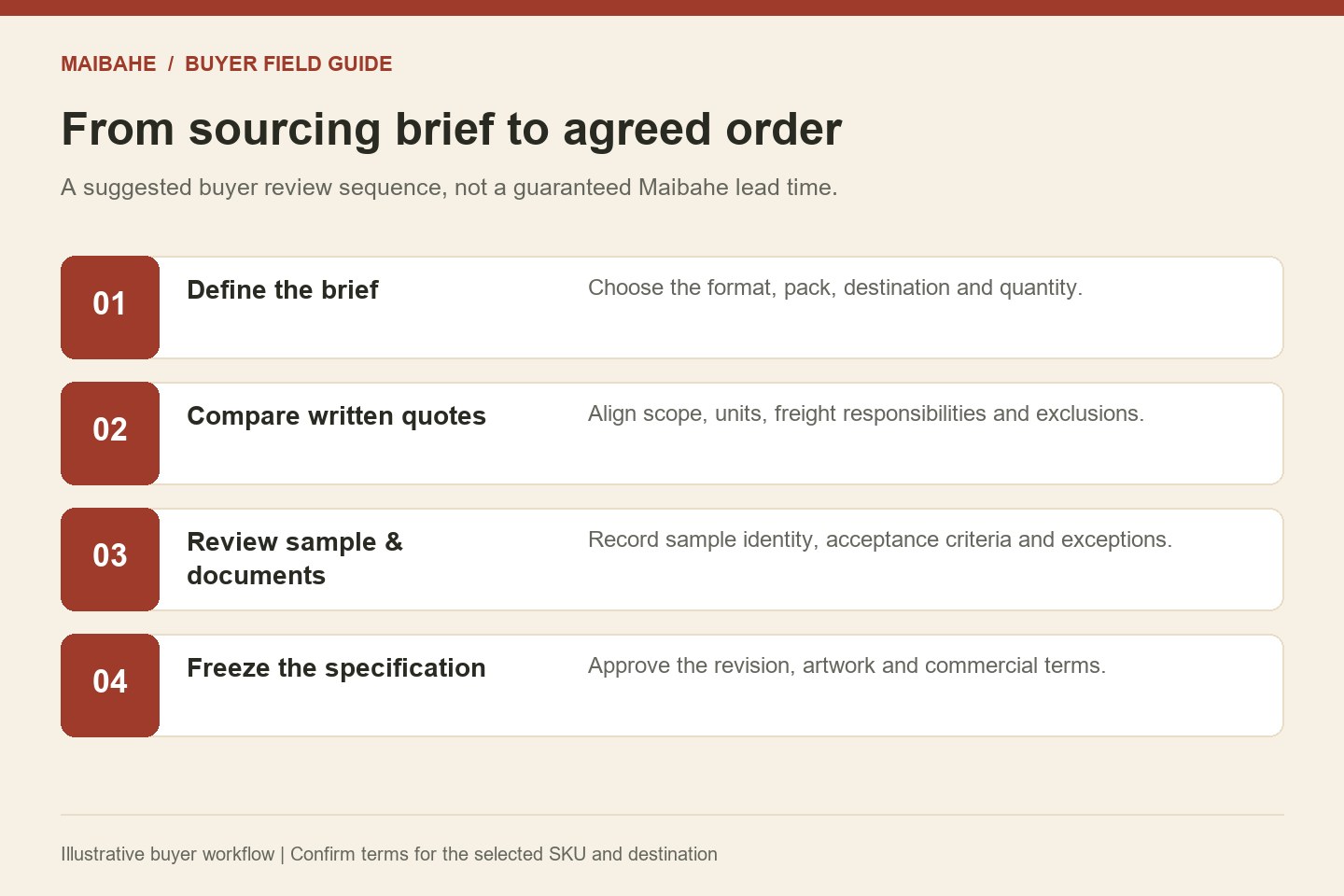
Keep the grain RFQ checklist, sample identity and written specification and review notes together. Record the preparation method if cooking or texture is part of the evaluation. Agree who approves the sample, how exceptions are handled and which specification revision will apply to the order. A visually attractive sample does not replace the agreed ingredient, pack or document requirements.
For a private-label project, keep the grain RFQ checklist and preserve the approved artwork version as well as the product specification. If a sample or label changes, ask whether price, MOQ, documents or schedule change with it. The grain RFQ checklist becomes an approval record when these decisions are written down.
Copy-ready grain RFQ checklist template
A reusable template helps buyers ask precise questions without turning the first message into a finished contract. Keep the fields you already know, mark flexible choices and ask the supplier to identify its proposed alternative. The grain RFQ checklist below is a suggested brief. Replace the bracketed entries with your requirements and remove anything that is not relevant to the product.
Product and quantity paragraph
“Our company is [company name], supplying [sales channel] in [destination country]. Please review [grain, format or catalogue reference] for [intended use]. Our proposed first order is [quantity and unit], covering [number of SKUs]. Our target net weight is [weight per pack]. Please identify the current SKU and confirm whether this format and pack can be offered. If you suggest an alternative, show the changed fields clearly.”
Packaging and branding paragraph
“We are considering [an existing label / private label] with [label language]. Our preferred pack is [format], with [carton or handling needs]. Please confirm the current packaging options and whether artwork, formulation or packaging development is included in the proposed scope. We will provide [available files] for review. Please identify any information you need before assessing feasibility, MOQ and production timing.”
Documents and samples paragraph
“Please tell us which current product specifications, ingredient and allergen information, labelled shelf-life and storage details, and relevant batch documents can be provided. We require review of [named claim or document requirement] for the selected product and destination. Please quote sample availability, quantity, charges, courier costs and any preparation or dispatch dependencies separately. Our sample review will assess [intended product characteristics] against the supplied specification.”
Commercial and timing paragraph
“Our desired arrival window is [date or range] at [named receiving point]. Please state quotation currency, validity, quantity basis, payment schedule, included work, delivery responsibilities and exclusions. Separate sample preparation, buyer approval, production, dispatch and transport estimates. Please identify the event that starts each estimate and the information required from us. This is a planning request; we will review the written offer before confirming an order.”
Attach the grain RFQ checklist as a dated brief or paste it into the inquiry message. Use one version number for the same request sent to different suppliers. If a supplier proposes another product or pack, keep the response beside the original fields. This makes a later comparison possible without treating every reply as if it matched the first request exactly.
Review a quotation without hiding the assumptions
A grain RFQ checklist is also a tool for reviewing the supplier’s answer. Read each price beside the product code, pack weight, total quantity and named delivery point. Check whether the reply covers the full order mix or only one line. Ask whether setup, artwork, development, samples or other requested work is included. An unspecified item should remain open until it is answered; do not silently treat it as included or free.
Keep a short clarification log with the grain RFQ checklist and four fields: the question, the supplier response, the decision and the person responsible. For example, “Our target is a 500 g pack; the proposal identifies an existing 750 g presentation. Buyer to review the alternative before the price is compared.” This is an illustrative scope note, not a statement that either pack is available for your order. It records the actual difference that needs a decision.
When a revised quotation arrives, use the grain RFQ checklist to compare it to the previous version. Identify which line changed and whether the change affects the other assumptions. A new pack may change carton configuration, artwork work or an order minimum. A changed destination may change the delivery basis. The grain RFQ checklist helps buyers ask about these connections without inventing a universal rule for every product or route.
If a supplier cannot provide a requested item immediately, ask whether it can be provided later, whether a different document is proposed, and what purchasing decision depends on it. Your team can use the grain RFQ checklist to decide whether the item is essential before approval or merely helpful for planning. Record that decision explicitly. Do not describe a pending document as reviewed, and do not describe a proposed sample as approved before your review is complete.
Keep a useful handover from inquiry to purchasing
The person who sends the initial inquiry may not be the person who approves the product or receives the goods. A short handover should identify the chosen supplier response, specification revision, sample reference, artwork version if relevant, quotation revision and unresolved questions. Link these records by product code and order scope. Store the same grain RFQ checklist with the handover so another colleague can understand why a particular proposal was selected.
Separate requirements from preferences in the grain RFQ checklist and handover. A required label language, an agreed ingredient statement or a documented acceptance criterion has a different status from a preferred carton arrangement that the buyer may change. If a preference changes during discussion, ask for the effect on price, pack or timing before approving the revised scope. Keeping the status clear reduces misunderstandings between purchasing, product review and the supplier contact.
Use the grain RFQ checklist to create a final open-items list before committing to production. It can include the current specification, sample approval, artwork approval, document availability, commercial terms and receiving responsibilities. Mark each item confirmed, pending or changed, with a date and the approving person. The grain RFQ checklist is complete for a purchasing decision only when your team has resolved the requirements it considers essential for that order.
For a repeat order, refer to the earlier product and specification revision, then ask for a current quotation and confirmation of any changes. Keep the new order quantity and delivery target distinct from the previous purchase. A repeat request can be concise, but it should still identify what is being repeated. The old grain RFQ checklist is a reference record; it does not make past price, availability or delivery assumptions current automatically.
Grain RFQ checklist questions buyers ask
What does RFQ mean in grain procurement?
RFQ means request for quotation. It asks a supplier to price a defined product and order scope. A useful request includes the quantity, packaging, destination and document requirements, rather than only asking for a price list.
Can I use a catalogue pack size as the export specification?
Use it to identify a format you want to discuss. Ask for the current SKU, pack, recipe and quotation. Maibahe’s published catalogue is historical reference material and does not establish current export availability.
Should I include a yearly forecast?
Yes, if it is clearly separate from the first order and labelled as a forecast. State the planning period, likely order frequency and assumptions. A forecast is not an instruction to produce that volume.
Does an inquiry reference confirm the quotation or email delivery?
No. A website inquiry reference confirms acceptance and recording of the inquiry. Commercial terms require a written quotation. Keep the reference for follow-up; it does not prove that a notification reached an inbox.
Prepare your Maibahe inquiry
Copy the grain RFQ checklist fields into your message: company, destination, sales channel, product format, proposed quantity, pack weight, branding needs, documents and desired schedule. Add any catalogue reference and describe which details are still flexible. Send your sourcing brief to Maibahe and retain the inquiry reference.
Related resources: historical product catalogue and buyer documents and wholesale buyer FAQ. For allergen review in a UK project, consult the official allergen guidance for food businesses and confirm the applicable requirements with your responsible reviewer.